
Repression, Unconscious and Subconscious –Easily Explained.
If you are interested repression, the subconscious or unconscious, this may be an informative web site for you. This web site offers a free self help course that involves working with the subconscious and the conscious and unconscious minds. By reading this web site, you will learn a theory or metaphor to which most patients can relate and use in a healing process. Here is how I learned this theory or descriptive metaphor to explain how the personality and subconscious were formed. I use this theory to establish rapport and use it extensively in the treatment of emotional issues.
I was trained in hypnosis and Neruolinguistic Programming so I worked a lot with peoples subconscious’ using finger responses, a hypnotic technique. In 1993, I was trained to do a new healing process that involves tapping on acupressure points. While using my new treatment method with one of my patients, her subconscious, it turned out, started tickling her under her nose on one of her acupressure points. This led me to find out that the subconscious could heal from the inside. I’ll give you an outline of the theory before we talk about repression.
I worked with many patients with difficult symptoms. From the above insight, I developed a model of the personality and brain functions. The figure shows a metaphor of the personality that has been validated by all of my patients.
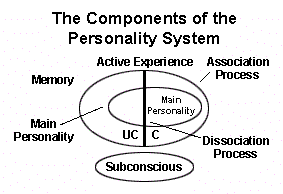
The Active Experience is a neural structure that operates on all internal and external sensory input, the current behavior, learned processes like, composing and editing of language, and all memories that are elicited into the active expedience by the content and emotions already active in the active experience. The active experience generates all overt and covert behavior.
The dissociation process, the heavy line down the middle, is an learned, active process that causes the conscious and unconscious split in the active experience. Since the main personality overlaps the dissociation process, there are conscious and unconscious parts of the main personality. The dissociation process is believed to be a process that works both automatically and voluntarily. In this metaphor or theory, repression is the voluntary or involuntary use of this dissociation process. An example of automatic repression is when you don’t hear sound when you are reading or see the hinges when going out a door. Voluntarily repression is obtained when you can say I never want to think about that again and you stop thinking about it. Another example is when a recurring painful experience is forgotten. It is really remembered but the dissociation process stops it from coming into your conscious experience. On this site, I develop the distinction between repression or dissociation and amnesia. Amnesia is not dissociation as you will discover by reading this site.
The subconscious never goes to sleep. It can be taught to heal any painful memory in the active experience. It is possible, then, to communicate with the subconscious and heal your emotional issues or aspects. This is a very safe and respectful healing process. In contrast to other clinical treatments, one can obtain rapport with all your personality and by healing learned pain in a special way, it is possible to heal even the most devastating trauma without flooding emotions into the conscious or unconscious mind. The subconscious can learn to heal all negative memories, beliefs and experiences just in the course of life.
Click on these links if you are interested in reading more details about how this was discovered, the theory, or a overview of the healing process . If you want to go directly to the Process Healing Course, then click on Process Healing.
I hope you find this web site interesting and helpful.
(N.B. The course referred to above is not currently full reconstructed from the Way Back Machine.)